Downtown Borrego Springs

Downtown Borrego Springs
Borrego Springs, CA Mainstreet

Thursday, July 14, 2011

Chilled cake? Texas Chocolate Sheet Cake!


We threw a fun western-themed party for my youngest son's graduation.  Pulled pork and brisket sandwiches were the "main event" (along with cold Shiner Bock beer!), but this Texas Sheet Cake stole the show!

Going back to the 1960's, my mom baked this cake for bbq's and picnics.  It feeds a crowd and may be the best chocolate cake I've ever had.  

It's a scratch cake made in a jelly-roll pan, topped with a fudgy warm chocolate and walnut frosting that soaks into the cake.  Buttermilk keeps the cake moist. 

 Cowboys and Indians Cupcake Toppers Toys


Mom kept our Texas Sheet Cakes refrigerated and served them chilled... a perfect, "cool" finish to a Borrego Springs meal! 

Cake Ingredients
2 C flour
2 C sugar
1/2 tsp. salt
1 tsp. baking soda
1/2 tsp. cinnamon
2 sticks (1/2 pound) butter  
1 C water
4 Tbsp. cocoa powder
2 eggs
1/2 C buttermilk
1 tsp. vanilla

Frosting Ingredients

1 stick (1/4 pound) butter
4 Tbsp. cocoa powder
6 Tbsp. buttermilk
1 pound (entire box) confectioners sugar
1 C coarsely chopped walnuts
1 tsp. vanilla

Mix dry ingredients in a large mixing bowl (flour, sugar, salt, baking soda, cinnamon).

Making The Cake
Heat butter, water and cocoa in a sauce pan.  Bring to a boil, stirring frequently.  Pour over the flour mixture. Mix together eggs, buttermilk and vanilla and then add to the dry ingredient mixture. Blend thoroughly.
Pour batter into a greased jelly roll pan (large cookie sheet with sides) and bake for 18 to 22 minutes in a 350 F. preheated oven.

To check if the cake is done cooking, insert a toothpick or knife into the center of the cake, which will come out clean if finished baking.  Don't overcook!  Remove from oven and frost while warm.

The Frosting (my favorite part)
Five minutes before the cake is finished baking, begin making your frosting.
 
Mix cocoa, butter and buttermilk in a saucepan. Bring just to a boil, then pull off the burner and immediately add powdered sugar and vanilla until well blended.  Fold in nuts.

Immediately pour warm frosting over the warm cake and spread as necessary.  Allow to cool before serving.
  
texas sheet cake pouring
MAKE YOUR FROSTING WHILE CAKE IS BAKING AND FROST WHEN BOTH ARE WARM


I think these guys ate some Texas Sheet Cake in their day!

BONANZA


Wednesday, July 13, 2011

Cacti from Cuttings or Division

Cacti can be expensive, so learning we would be able to root cuttings or divide them from our existing plants was really great news! 

The first time I learned this, I watched our gardener cut an agave offshoot from our front bed, which he told me was the cactus "bebĂ©".  Then he tucked it into an open space in the flower bed and pressed the dirt around it.  No rooting solution, no preparation.  He was so confident that it would grow into another big plant and seven months later, I can confirm he was right!  
Most cacti will come out of their winter rest around spring and will begin to grow - a great time to start a few new plants. 

Cuttings
Rooting a cactus cutting is much easier than rooting most other types of plants. Healthy pad-forming, columnar or segmented stem cacti are very easy to start from cuttings.   

1)  Cut the pad off with a clean, sharp knife. If the pad is large or woody, you can use a saw.  Unlike most plants, cacti love to be clipped and started in warm weather.  Late spring and summer are the best times.  

2) You could just stick the thing in the ground at this point, but for best results, dry the cutting in a dry, shady place until the cut area forms a callus.  This will take a few days to a week.  The larger the cut surface, the longer you should allow the cutting to dry.  Don't water the cutting during this time. 

3) Once the cutting is ready for planting, plant directly into your garden or in pure sand or a well-draining soil mixture (sand, perlite, pumice, gravel can be combined for a very good planting medium).

4) Water. After a couple of days, check the soil and water again after the soil is completely dry.  Continue watering until the winter months, when watering can be done on your normal drip or sprinkler system setting according to your flower bed's particular situation.

Root rot is a concern and may cause your cutting to die.  Don't over-water your cuttings!

Agave shawii leaves
Division
Division is an ideal method of propagating those types of cactus which bud off new plants from the side of the mother plant. These babies usually already have roots developed and should be carefully pulled or teased away from the parent plant and placed in a place of their own. The advantage of this type of propagation over the taking of cuttings is that division leaves the mother plant with almost no signs of disfigurement (e.g. natural childbirth vs. cesarean).


When it comes to soil type, cacti aren’t particular, but they do need good drainage.

Be Careful!
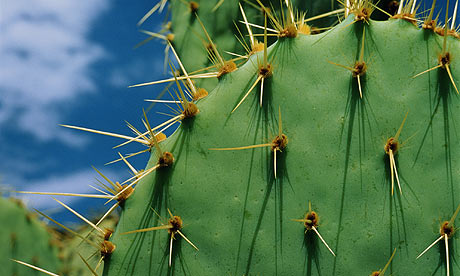
Prickly pears (Opuntia) have fine bristles, known as glochids, that fly off the plant with the merest disturbance. They’re relentless, invading cloth and skin, and they take a good washing with hot soap and water to remove.

Chollas (Cylindropuntia) have barbed spines that are downright painful – especially when you try to pull them out of pricked skin. And the spines on most other cactus are just plain sharp.The best strategy for moving prickly pears and chollas is to use tools. Never try to handle a piece of any prickly pear or cholla with your hands, even when wearing gloves!
For those wanting to learn more about the giant saguro cactus, here's a great book that we have on our Borrego Springs bookshelf for our younger guests.  Desert Giant is available at Amazon.com.

Saturday, July 9, 2011

Uncommon and unspoiled. The Borrego Springs Life Experiment


The Very Happy Mr. W. and I live in a nice, older neighborhood ten minutes from downtown Seattle in a comfortable four-bedroom view home. We have alot of stuff. We are very happy.  But for the past couple of years, as semi-empty nesters, serious conversations have been focused on the next "phase" of our lives -- the "without the kids phase".
Get full resolution light-blue-clouds image for free!
What do we want our lives to look like?
What will make us happy?


When our kids start having kids, we want to live near them and play a significant roll in our grandkids' lives;

Spending more time during the year in a sunny location with (affordable) golf would make us happy;


An inexpensive vacation home would allow us to keep a home in Seattle;
We would like a house (with a yard for gardening), rather than a condo, but also something that makes every day feel like a vacation;

Goal is to live healthy, active lives.

The simpler, the better, so that we can focus on what is really important - family, friends, "experiences" rather than "things", spending time outside and appreciating nature.


We started visiting warm locations and looking at real estate... Scottsdale, Phoenix, Tucson, Maui, Las Vegas, Palm Springs, central Oregon, Southern California. All of these could work, but would likely result in our living a somewhat fast paced, expensive lifestyle while there - dealing with traffic and lines, and surrounded by tons of shopping, $100+ rounds of golf and expensive restaurants. 


The places we researched and visited with a "second home" destination in mind ended up feeling an awful lot like Seattle after we had been there a few days. Life in those places would not necessarily be different than our life in Seattle.  Then we visited Borrego Springs.   

Borrego Springs, CA : Borrego Springs
Borrego Springs people are friendly and down-to-earth;
The desert is breathtakingly beautiful;
It's really quiet in the middle of nowhere;
There are always stars in the night sky;
The desert is alive!  Filled with animals, cacti and flowers;
Most of the year, the days are warm and nights are chilly
(perfect for a cozy fire);
Anza-Borrego Desert State Park has dozens of amazing hiking trails and jeep/off-roading areas;
You can get by and be really happy with much less stuff than you think;
When removed from the distractions of a larger city, the days go on forever;
Desert flower beds are a dream to dig in;
There is no problem getting a tee time in Borrego Springs;
It's relatively difficult to spend money in Borrego Springs;
People care about and support each other in a small community;  
Humans can live without Starbucks (nearest Starbucks is 40 minutes away);
FedEx/UPS deliver to Borrego Springs every day;
A nice, comfortable home in Borrego Springs is quite affordable.


Borrego Springs "Christmas Circle"


Sunday, June 26, 2011

Borrego Springs Herb Garden


HERB: 
A plant that is useful in some way.

I love to grow herbs that we can use for cooking or that add a fresh, memorable smell to the garden. 

I've got a decent herb garden in Seattle.  And since we purchased the little Borrego Springs house in December, I've planted the beginnings of an herb garden - mint, aloe, Spanish lavender, culinary sage, mountain sage, Greek oregano and "Tuscan Blue" rosemary. 

So far, so good, but the lavender does look a little scrawney and is likely getting too much sun right now.  

Spanish Lavender's rabbit ears
SPANISH LAVENDER
Most herbs can tolerate full sun, but healthy well-balanced growth (known as "vigor") will be increased with some afternoon sun protection in Borrego Springs.

We have a great flower bed directly outside of our "back door", which is off the kitchen and is partially shaded in the afternoon!  The location makes it so convenient to pick fresh mint for The Very Happy Mr. W's mojitos, pick rosemary to garnish a roast, or cut a few stocks of fresh lavender to stick in a small vase next to our bed. 

Herbs, like most plants, need a solid root system by the time the weather begins to heat up, so the best "planting" season for many herbs begins in mid-August and runs until the end of March or April.  We will all have better results if we practice self discipline and stick to a planting schedule that is best for the plant!  Good luck with that. 

Salvia dorrii is a hard to find desert sage with attractive deep blue flowers and light gray foliage.
DESERT SAGE (Salvia dorrii)
 I find myself unable to resist the 4" herb starts sold at the Borrego Springs Friday farmers market through May.  They are healthy little plants and very inexpensive!  

BASIL (MY FAVORITE!)

 
DILL
Many of the herbs that thrive in our harsh desert environment are of Mediterranean origin. Soil types, low rainfall and over 300 sunny days a year allow these familiar herbs to grow easily in Borrego Springs gardens.  

While many culinary herbs are perennials, some of them are seasonal annuals and must be grown in either the cool season or the warm season here in the low desert.  For example, annual cilantro and dill can be planted in the fall to grow months. 


Parsley, normally a biennial lasting two years, may not endure summer in Borrego Springs.

Some perennials such as culinary chives, French tarragon, and Mexican tarragon may disappear underground for the winter, re-sprouting with fresh growth the following spring. 

Ancient Greeks used Sage as a mental stimulant.  Sage is in the genus of Salvia, and is associated with salvation and good health.

Rosemary (a Mediterranean native) has been used for centuries for scenting and medicinal purposes.  It is associated with remembrance and fidelity because of it’s long-lasting piney aroma.  Rosemary is the symbol of friendship and loyalty.

I have been told that basil, commonly an annual in other regions, can last more than one season in the low desert if protected from frost.  I need to learn how to do that! 
The History of the Mint Plantthumbnail
MINT


Mint and lemon-flavored herbs (e.g. lemon verbena) are among the most popular for herbal teas.  With the variety of these plants that thrive in the low desert, along with other flavored herbs, you can grow your own tea blend!  As a general rule, use one teaspoon of dried herbs, or two teaspoons of fresh herbs to each cup of boiled water for tea.


A couple of my favorite herb recipes:

Gremolata
  • 1/4 cup chopped fresh flat-leaf parsley 
  • 1 teaspoon minced rosemary leaves
  • Zest of one lemon
  • 2 cloves garlic, minced
  • Pinch salt
  • Pinch freshly ground black pepper
  • 2 teaspoons good olive oil
Mix together.  Serve with roasted meats or use as a garnish for lasagna or other pasta dishes for a fresh punch of flavor.


CURLEY (USUALLY FOR GARNISH) & FLAT LEAF (PREFERRED BY COOKS) PARSLEY
Basil Pesto

  • 1/4 cup walnuts*
  • 1/4 cup pine nuts*
  • 3 tablespoons minced garlic (9 cloves)
  • 5 cups fresh basil leaves, packed
  • 1 teaspoon kosher salt
  • 1 teaspoon freshly ground black pepper
  • 1 1/2 cups good olive oil
  • 1 cup freshly grated Parmesan cheese 
*using all walnuts or all pine nuts will be delicious too.

Place the walnuts, pine nuts and garlic in a food processor.  With the standard blade, process for 30 seconds, then add the basil leaves, salt and pepper.  Keep  processor running and slowly poor in the olive oil until the pesto is thoroughly pureed.  Add the Parmesan and puree for another minute.  

You can use the pesto immediately or store it in the refrigerator.  I like to freeze the pesto in ice cube trays, which makes a nice portion for a family pasta dinner.  Spray the ice cube trays with Pam olive oil spray, fill with the pesto mixture, spray again with the Pam olive oil and freeze.  After frozen, the cubes of pesto can be stored in a zip-lock freezer bag.  

Tip:  Don't "cook" pesto.  Add it to your recipe at the last minute, allowing it to melt into the dish.


Saturday, June 25, 2011

"Can you hear me now?" Howling Coyotes!


There are coyotes in Borrego Springs.  I'm fascinated by them.  They are part of the desert landscape and a constant topic of conversation between dog and cat owners around town.


We have been told many times, as new residents, to watch our dogs and not let them be alone outside because of the coyotes.  We have two golden retrievers, Yogi (13) and Woody (2), that have been known to make a road trip from our home in Seattle to Borrego Springs. 

ImageI hadn't  taken the locals' advice all that seriously, believing Yogi and Woody can stand up to any 'ol coyote.  Until the next door neighbors, who have two dogs, said in previous years there have been huge packs of coyotes (a dozen+) roaming the deAnza Golf Course.  
 
There has been a "lost" poster on the bulletin board at the Center Market that includes a picture of a small missing dog.  All of us who saw that poster were thinking the same thing.  

coyote pups
PRACTICING THE HOWL
    
The scientific name for coyote is Canis latrans, which means barking dog in Latin. 

Coyotes are smaller than wolves and are sometimes called prairie wolves or brush wolves.  Members of the dog family, they weight about 15-45 pounds, are 40" to 60" inches (including tail) and 15" to 20" high at the shoulder.


The coyote is an important spiritual symbol for many indigenous tribes and appears often in the tales and traditions of Native Americans, usually as a savvy and clever beast.  He is seen both as a trickster causing trouble and as a provider of many good things for this world.


Modern coyotes have displayed their cleverness by adapting to the changing American landscape. They once lived primarily in open prairies and deserts, but now they are virtually everywhere.  During a coyote class at the Anza-Borrego Desert State Park headquarters learning center, my nephew Sammie and I learned that the Coyote population is likely at an all-time high.

Coyotes form strong family groups.  In spring, females den and give birth to litters of two to twelve pups.  Both parents feed and protect their young and their territory. The pups are able to hunt on their own by the following fall.  When coyotes are about two years old, they select a mate and stay with that mate for life.

Coyotes have 42 teeth in a strong jaw - perfect for holding and biting prey. Their senses of smell, sight and hearing are exceptional which makes them very cunning hunters.

When hunting, coyotes frequently pursue prey in relays, enabling the pack to nip at prey and run down animals that could escape a single coyote.  They  can run in bursts up to 40 miles per hour and can jump an 8' fence. Coyotes can also travel up to 400 miles at a stretch.


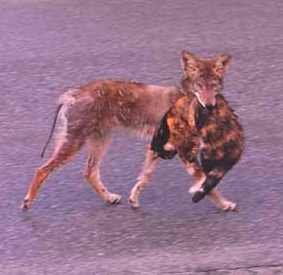
Coyotes eat almost anything.  They hunt rabbits, rodents, fish, frogs, and even deer.  They also happily dine on insects, snakes, fruit, grass, domestic pets and our garbage. 


Coyotes will deposit scat in prominent places, where other animals are likely to find it.  Coyote scat has a "twisted" characteristic and you can easily identify what the animal has been eating.


Coyotes communicate through barking, growling, yapping and howling.  They are known for their distinctive call which can develop into a canine chorus at night. 


When a coyote is scared, it will hold its head low and tuck its tail between the legs.  When agressive, the coyote's tail becomes bushier and turns sideways.
Coyotes maintain their territory by marking it with urine.


Coyote parents supply live mice to their pups for hunting practice...


kind of like giving car keys to the kids!


coyote 13 10 Facts You Did Not Know About Coyotes

I discovered a wonderful blog while working on this post.  Check out The Daily Coyote (www.dailycoyote.net), about Charlie, an orphaned coyote raised by a family.   

Image of Print ~ Enjoying The Sunset
Charlie - www.dailycoyote.net