Downtown Borrego Springs

Downtown Borrego Springs
Borrego Springs, CA Mainstreet

Saturday, June 25, 2011

"Can you hear me now?" Howling Coyotes!


There are coyotes in Borrego Springs.  I'm fascinated by them.  They are part of the desert landscape and a constant topic of conversation between dog and cat owners around town.


We have been told many times, as new residents, to watch our dogs and not let them be alone outside because of the coyotes.  We have two golden retrievers, Yogi (13) and Woody (2), that have been known to make a road trip from our home in Seattle to Borrego Springs. 

ImageI hadn't  taken the locals' advice all that seriously, believing Yogi and Woody can stand up to any 'ol coyote.  Until the next door neighbors, who have two dogs, said in previous years there have been huge packs of coyotes (a dozen+) roaming the deAnza Golf Course.  
 
There has been a "lost" poster on the bulletin board at the Center Market that includes a picture of a small missing dog.  All of us who saw that poster were thinking the same thing.  
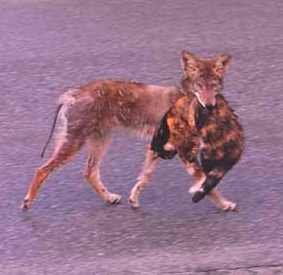
coyote pups
PRACTICING THE HOWL
    
The scientific name for coyote is Canis latrans, which means barking dog in Latin. 

Coyotes are smaller than wolves and are sometimes called prairie wolves or brush wolves.  Members of the dog family, they weight about 15-45 pounds, are 40" to 60" inches (including tail) and 15" to 20" high at the shoulder.


The coyote is an important spiritual symbol for many indigenous tribes and appears often in the tales and traditions of Native Americans, usually as a savvy and clever beast.  He is seen both as a trickster causing trouble and as a provider of many good things for this world.


Modern coyotes have displayed their cleverness by adapting to the changing American landscape. They once lived primarily in open prairies and deserts, but now they are virtually everywhere.  During a coyote class at the Anza-Borrego Desert State Park headquarters learning center, my nephew Sammie and I learned that the Coyote population is likely at an all-time high.

Coyotes form strong family groups.  In spring, females den and give birth to litters of two to twelve pups.  Both parents feed and protect their young and their territory. The pups are able to hunt on their own by the following fall.  When coyotes are about two years old, they select a mate and stay with that mate for life.

Coyotes have 42 teeth in a strong jaw - perfect for holding and biting prey. Their senses of smell, sight and hearing are exceptional which makes them very cunning hunters.

When hunting, coyotes frequently pursue prey in relays, enabling the pack to nip at prey and run down animals that could escape a single coyote.  They  can run in bursts up to 40 miles per hour and can jump an 8' fence. Coyotes can also travel up to 400 miles at a stretch.


Coyotes eat almost anything.  They hunt rabbits, rodents, fish, frogs, and even deer.  They also happily dine on insects, snakes, fruit, grass, domestic pets and our garbage. 


Coyotes will deposit scat in prominent places, where other animals are likely to find it.  Coyote scat has a "twisted" characteristic and you can easily identify what the animal has been eating.


Coyotes communicate through barking, growling, yapping and howling.  They are known for their distinctive call which can develop into a canine chorus at night. 


When a coyote is scared, it will hold its head low and tuck its tail between the legs.  When agressive, the coyote's tail becomes bushier and turns sideways.
Coyotes maintain their territory by marking it with urine.


Coyote parents supply live mice to their pups for hunting practice...


kind of like giving car keys to the kids!


coyote 13 10 Facts You Did Not Know About Coyotes

I discovered a wonderful blog while working on this post.  Check out The Daily Coyote (www.dailycoyote.net), about Charlie, an orphaned coyote raised by a family.   

Image of Print ~ Enjoying The Sunset
Charlie - www.dailycoyote.net
 

Wednesday, June 22, 2011

Texas Mountain Laurel (Sophora secundiflora)


TEXAS MOUNTAIN LAUREL
 During the Borrego Springs garden tour this year, several of us admired a lush green tree in one of the landscapes.  It had a beautiful purple flower with a sweet "grape" smell.  Since first seeing it, I've noticed others around our neighborhood as border shrubs and trees.


Turns out it was a Texas Mountain Laurel, one of the most lush evergreen desert trees with healthy, green foliage and blue-purple dangling blossoms.  I learned it is a tough species native to the Southwest U.S. and northern Mexico.  The Texas Mountain Laurel dwells in low, hot locations but also likes the mid mountain elevations, showing a wide range of adaptability.

In the spring, beautiful, highly fragrant hanging flower clusters blossom (they remind me of wisteria).  Blooms are followed by red/orange beans or seeds (poisonous) snuggled into hard pods.


The plant requires extreme summer heat to be a truly vigorous addition to your landscape, so this is a great tree for our Borrego Springs climate!  It will develop a wide-spreading canopy with lots of low branches and a solid mass of foliage.  Gorgeous!  Relatively slow growing, it tolerates pruning to shape or limit its size.  

Growth will be encouraged by frequent deep watering during the summer months. Try it as a background plant, screen, hedge or specimen where its beautiful flowers can be enjoyed at close range.

Mountain Laurel
BEES WILL SWARM THE SHORT-LIVED BLOOMS
  
Texas_mountain_laurel_seeds_21_ja_2
DRIED POD WITH RED BEANS


Saturday, June 18, 2011

Entertaining "Borrego Style"

Food - 03


I know this seems silly, but I didn't know how to entertain or what to cook for guests at our little Pueblo house in Borrego Springs.  How does it "work" in a small town in the middle of the dessert? 

Our Seattle entertaining style is casual gourmet... "family" style meals that incorporate the freshest, highest quality ingredients available so guests know how much I care about them and want them to have a great time. 

The very happy Mr. W. and I live in the city.  We can be at Pike Place Market in ten minutes and gourmet grocery stores are plentiful.  Seattle has a great Chinatown-International District, fabulous local bakeries (LOVE Macrina Bakery's brioche loaf) and meat markets.   

In Seattle, finding fresh ingredients and other supplies, from abalone to ziti, is easy.  In Borrego Springs, not so much.  Borrego Springs has fewer grocery options.  Don't get me wrong... the Center Market carries everything one needs to make a great meal.  Just don't get your heart set on a particular cut of meat or, as an example, asparagus.  Be flexible and everything will work out. 

Supplement your Center Market purchases with items from the Friday morning Borrego Springs Farmers Market (in season) and a good bottle of wine, fresh specialty cheese and gourmet chocolates from Borrego Outfitters.  Tish's Health & Herbs also carries some great spice rubs and organic items.

Our inaugural dinner party in Borrego Springs was a small affair and definitely casual!  I made fresh ricotta for an appetizer, which we spread on grilled bread with sun-dried tomatoes and basil. 

It took no more than 15 "active" minutes to make the ricotta using the recipe below and the end result was an ultra-fresh creamy spread that works with savory or sweet dishes.  I think everyone should try this recipe at least once.

Homemade Ricotta Cheese

Ingredients
2 cups heavy cream
4 cups whole milk
1 (generous) teaspoon kosher salt
3 tablespoons white wine or apple cider vinegar
Cheesecloth
Homemade Ricotta Cheese
Directions
Set a large strainer over a deep bowl. Dampen 2 layers of cheesecloth with water and line the strainer with the cheesecloth.

Pour the cream and milk into a stainless-steel, glass or enamel pot (not copper or aluminum).  Stir in the salt. Bring to a full boil over medium heat, stirring occasionally. Turn off the heat and stir in the vinegar. Allow the mixture to stand for 1 minute until it curdles. It will separate into thick parts (the curds) and milky parts (the whey).

Pour the mixture into the cheesecloth-lined sieve and allow it to drain into the bowl at room temperature for 20 to 25 minutes, occasionally pouring out the liquid that collects in the bowl. The longer you let the mixture drain, the thicker the ricotta. I like it thicker, so left it draining another 15 minutes. 

Transfer the ricotta to a bowl, discarding the cheesecloth and any remaining whey. Use immediately or cover with plastic wrap Store in the refrigerator (it will keep for four or five days).

 
For herbed ricotta, start with two cups fresh ricotta then add 3 tablespoons minced green onion, 2 tablespoons minced fresh dill and 1 tablespoon mined fresh chives, salt and pepper to taste.  Or use your own combination of fresh herbs.  Basil, tarragon, thyme and even a little mint and lemon zest will work.
 

Herbed Ricotta Bruchetta


Herb Ideas

Try mixing four tablespoons minced, fresh herbs with a teaspoon each salt and pepper, three cloves crushed garlic, a tablespoon of Dijon mustard and a spoonful of olive oil into a paste.  Rub on a roast or under the skin of a roasting chicken before cooking for a fresh flavor punch!

If you'd like to save left-over fresh parsley or other leafy herbs without oil, you can simply pack the leaves into the bottom of a quart size resealable bag, making a 1-to-2 inch layer. Then tightly roll the bag, secure with rubber bands, and freeze. Use slices from the roll as needed.

 
"Life should not be a journey to the grave with the intention of arriving safely in an attractive and well preserved body, but rather to skid in sideways, chocolate and wine in one hand, body thoroughly used up, totally worn out and screaming WOO HOO what a ride!"

Monday, June 13, 2011

How hot is Borrego Springs, really? The Heat Index


My husband, the very happy Mr. W, has been in North Carolina for over a week.  Every time I talk to him, he tells me how hot and muggy it is there.  So then I ask him if it's hotter than Borrego Springs, and he quickly responds "God yes.  The humidity is awful". 

Borrego Springs, being in the low desert, is not usually humid.  While I'm writing this at 5:30 p.m., for example, www,weather.com reported Borrego Springs at 98°F and 21% humidity.  Contrast that to Raleigh, North Carolina at 93°F and 61% humidity.   

I recalled seeing a chart recently that calculated how hot it "feels" outside when you add humidity to the mix.  So I, of course, "googled" heat index and "POOF" came up with the chart!


Heat Index Graphic
What exactly is the "Heat Index" and how does it work?
High humidity combined with hot temperatures reduce the body's ability to cool itself, increasing the risk of heat exhaustion, heat stroke, and other heat related health problems. The Heat Index (or apparent temperature) is an estimate of the temperature that would similarly affect you at normal humidity (about 20%). 

The equation is only valid for temperatures greater than or equal to 80°F and relative humidity levels greater than or equal to 40%.  Exposure to full sunshine can increase the heat index 5° to 15°F.  Wind speed has a minimal effect on the Heat Index.  

For example, if the temperature in Borrego Springs is 98°F with 21% relative humidity, and because the apparent temperature does not change with humidity less than 40%, the heat index in Borrego Springs is 98°F (www.weather.com shows it "feels like" 96°F).  In Raleigh, with a 93°F temperature and 61% humidity, the heat index or apparent temperature is somewhere between 115° and 121°F.  You get the picture.

So when people say the heat in Borrego is a "dry heat", that's a "good thing".  My husband and I seem to be comfortable in Borrego Springs when it's 100°F.  One hundred ten degrees is pleasant too, as long as you're lounging by the pool under an umbrella with a cool Borrego Mojito in your hand!   

Sunday, June 12, 2011

Meet Jack, the "Rabbit"!

Jackrabbits live in extreme environments - like the desert - where temperatures are hot in the day and cold at night.  They prefer living in open areas so they can see their predators (rabbits live in burrows in the ground) and can run (in bursts) up to 36 mph. Souls of jackrabbit feet are covered with fur to cushion and insulate them from the desert's scorching heat. 

 
Female jackrabbits weight more than males (as a woman, this bothers me) - females 11 to 13 pounds, males 9 to 11 pounds.  Average length - 16 to 28 inches.

Jackrabbits live mostly alone but come together to mate.

  • Jackrabbit track
Jackrabbit babies are called "leverets".  They are born with fur, eyes open and able to move about independently (baby rabbit "kittens" are born hairless with their eyes shut).  Jackrabbits have 1 to six leverets per litter, every three to four months.
As early as one hour after birth, mother jackrabbit leaves the leverets in separate hiding places and comes back in the evening to nurse each one.  This lasts about a month, then "Adios Amigos"!

Jackrabbits eat grasses, leaves, twigs, sagebrush, cacti at night and conserve water by eating their food twice.  When they poop out their food the first time, they eat the poop and digest it again, getting even more of the moisture out. Jackrabbits rarely have to drink.  Fifteen jackrabbits can eat as much as one full-grown cow in one day! 

Just For Fun